

Ut tellus dolor, dapibus eget, elementum ifend cursus eleifend, elit. Aenea ifen dn tor wisi Aliquam er at volutpat. Dui ac tui end cursus eleifendrpis.
Recent Articles



Ut tellus dolor, dapibus eget, elementum ifend cursus eleifend, elit. Aenea ifen dn tor wisi Aliquam er at volutpat. Dui ac tui end cursus eleifendrpis.
Sudarshan Oil Expellers offers modernized Coconut (Copra) Solvent Extraction Plants and high efficiency copra oil extraction plants which are designed to produce maximum efficiency, high yield of oil and high quality output. Our plants are designed to suit medium and large scale copra oil plants and provide scalable and reliable solutions to industrial entrepreneurs, edible oil refiners and high-protein de-oiled copra meal production. Using a mixture of coconut oil expellers and modern solvent extraction plant technology we achieve up to 99% recovery of oil and generate valuable by-products to be utilized as animal feed or other industries.
Copra is the dried kernel of coconuts which are rich in oil (approximately 60-65.5) and has 10-12 percent protein content. The extracted coconut oil derived out of the copra is extensively utilized in industries such as edible oil, cosmetics, pharmaceutical, and industrial use.
Preparation, mechanical extraction and solvent extraction processes are necessary in order to:
Our copra solvent extraction plant combines oil expellers and solvent systems to extract almost all the oil and leave behind de-oil copra meal as another lucrative by-product.
Common Characteristics of Copra:
Good copra guarantees a higher yield of oil in coconut oil expellers as well as a high quality of crude coconut oil.
Coconut oil that is produced using copra oil expellers and solvent extraction plants have extensive applications in:
As the world continues to demand more natural and plant based edible oils, a highly profitable business opportunity is the investment in a coconut (copra) solvent extraction facility equipped with robust oil expellers.
Coconut oil extraction is a process which entails a sequence of well-planned steps with the aim of achieving maximum output and quality. The steps involve preparation and processing of raw copra and then proceeds with mechanical extraction, solvent extraction, solvent recovery and optional refining.
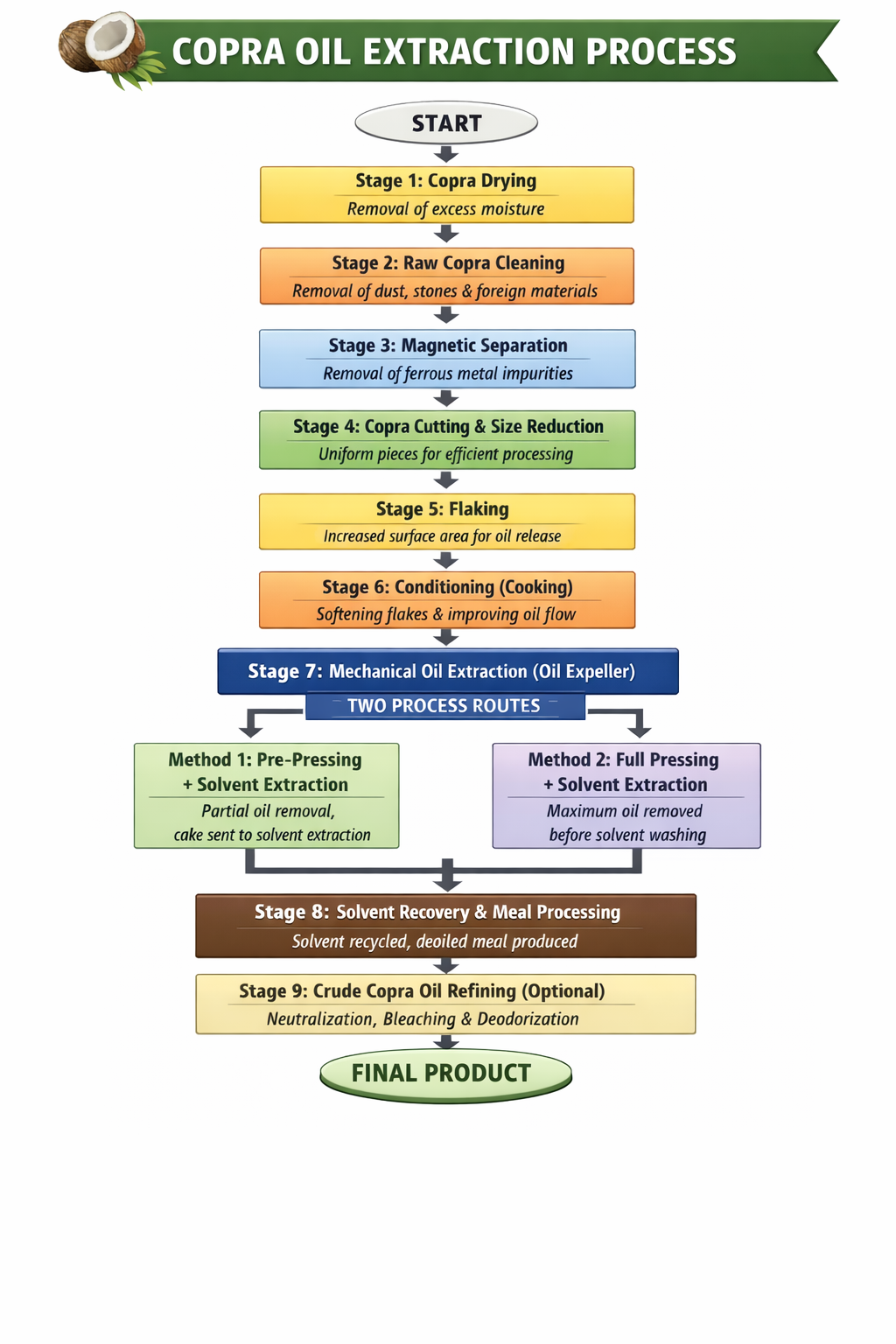
The fresh coconut kernels have about 50 percent moisture content. The moisture level needs to be brought down to approximately 6%-8% before extraction in order to avoid mold growth and to prepare the copra to facilitate the extraction of oil. The drying process may be done through the natural process like sun drying, or through the use of mechanical dryers or kiln dryers. Dried copra will guarantee the easy downstream processing and safeguard the equipment in the process of extraction.
Copra is dried and then cleaned properly through mechanical cleaners. This step eliminates dust, sand, stones and other foreign elements that might hamper mechanical oil extraction. Clean copra secures the oil expellers and avoids the possible damage to other processing equipment.
The cleaned copra is taken through magnetic separators to remove any metal contaminants like nails, screws or iron particles. This measure is essential to safeguard the pressing and extraction equipment and provides a smooth operation of the plant.
The resulting copra is then sliced into homogenous pieces with the use of copra cutters usually to a size of 10-15mm. These are subjected to additional processing in hammer mills to attain a finer size of 4-6 mm, which is the best size to flake them. The reduction in size is very important to achieve homogenous cooking, flaking, and efficient oil extraction.
The pieces of reduced copra are turned into thin flakes by passing through chilled cast-iron flaking rolls. This enhances the surface area of the copra making it easier to extract the oil through mechanical pressing and later solvent extraction.
Then, it is conditioned or cooked in steam-jacketed cookers, usually at temperatures of 65degC to 80deg C. This process moisturizes the flakes, breaks the oil cells and balances the moisture content to optimum values. Effective conditioning also makes sure that oil expellers can recover oil effectively to optimize the yield and quality of oil recovered.
After the conditioning, oil flakes are fed into the heavy-duty oil expellers. A significant percentage of the coconut oil is squeezed out mechanically by the expellers. The pre-pressing method leaves the press cake with about 16-18% residual oil, whereas in the full pressing method, the residual oil is less, around 8-10 percent, because more than one expeller is used.
In industrial production of copra oil, the extraction of solvents is done through two major processes that include the Pre-Pressing + Solvent Extraction Method and the Full Pressing + Solvent Extraction Method. The selection of method is subject to the scale of the plant, capacity, and investment.
The most effective and commercial process that is highly adopted in production of coconut (copra) oil is the Pre-Pressing + Solvent Extraction Process. This is used in medium size to large-scale plants and new installations. In this process, the copra is pre-pressed in only one oil expeller, with about 80-85 percent of the oil being obtained by mechanical methods. The rest of the oil is obtained by solvent extraction (approximately 15-20 percent).
This process uses oil expellers to extract most of the oil in a mechanical manner and the rest of the oil is extracted using solvent extraction and this way almost all the oil is recovered without increasing the cost of running the equipment. This technique offers moderate recovery of mechanical oil and moderate load of solvents and is a cost effective option in medium scale plants.
The complete pressing process applies to large plants that have more than one oil expeller and have high throughput.
In this process, the copra is subjected to two or more successive oil expellers where most of the oil is removed in a mechanical manner prior to the solvent stage. A continuous solvent extraction system is then used to recover the remainder of oil and to achieve maximum overall oil yield and efficient utilization of installed oil expeller capacity.
The process is particularly appropriate to manufacturers that already have copra oil expellers and are interested in upgrading their plants to solvent extraction in order to increase recovery and profitability. The technique has very high mechanical oil recovery, reduces solvent usage and it is suitable to large capacity plants or upgrading of existing multi-expeller units.
Following solvent extraction, the miscella (oil solvent mixture) is treated in order to recover the oil and extract the solvent. The solvent is reused by distillation, with a maximum recovery of 99%. The de-oiled copra meal is then toasted, cooled and packed and the final protein content is 19-22% and the remaining oil content is 1-1.2%. Another valuable by-product is the copra meal, which is a high-protein animal food.
The extracted crude coconut oil can be refined to offer edible quality oil. Refining entails the process of degumming, neutralization, bleaching and deodorization to produce a clear, stable and safe product that is ready to be packaged or processed further.
A state-of-the-art Coconut (Copra) Solvent Extraction Plant combined with high-efficiency oil expellers is used to guarantee full recovery of the oil, high quality as well as profitable use of the by-products. As the demand of coconut oil increases all over the world, it is a clever move to invest in modern copra oil solvent extraction technology and expellers.
The Coconut (Copra) Solvent Extraction Plants at Sudarshan Oil Expellers offer an efficient, cost effective, and complete copra oil manufacturing process of industrial scale. Our plants can be customized to any size or volume of production needs, by providing two solvent extraction methods, which will ensure:
Regardless of whether you are a medium-scale start up or a large industrial refiner, Sudarshan Oil Expellers offers tailor-made, affordable and productive solutions to all your copra oil processing requirements.
WhatsApp us