

Ut tellus dolor, dapibus eget, elementum ifend cursus eleifend, elit. Aenea ifen dn tor wisi Aliquam er at volutpat. Dui ac tui end cursus eleifendrpis.
Recent Articles



Ut tellus dolor, dapibus eget, elementum ifend cursus eleifend, elit. Aenea ifen dn tor wisi Aliquam er at volutpat. Dui ac tui end cursus eleifendrpis.
Soybean oil is the most preferred and consumed edible oil all over the world. It is highly praised for its different usage, nutritional value, and wide consumption in different industries and thus, it enjoys the highest demand globally. Soybean oil is widely used and accepted in the food industry for its neutral taste, light color, and high smoke point; hence, it is suitable for all kinds of cooking, frying, bakery, and food processing applications.
The food sector is the main driver of the demand for soybean oil; however, the poultry, dairy, aquaculture, and livestock feed industries also support it by having an increasing demand for high-protein soybean meal (DOC). Due to its 44–48% protein content, soybean meal is extensively used as a main ingredient in feed formulations across the globe.
Soybean oil mills are an attractive investment for investors as they can generate revenues from two sources, i.e., production of refined soybean oil for human consumption and de-oiled soybean meal for livestock feed. This combination not only assures profitability but also lowers business risk and preserves sustainability in the long run.
Moreover, the constant supply of soybean seeds and the rise in domestic consumption and stable global feed demand make the setting up of a commercial soybean oil plant in India and elsewhere an investment that is not only strategic but also profitable.
Sudarshan Engineering Works provides turnkey solutions for Soybean Oil Mill Plant tailored to your production targets, energy requirements, and automations needs. Whether your target is a compact 10–20 TPD unit or a big industrial 200–1,000 TPD setup, our engineering will make the operation of your plant smooth, continuous, and efficient with high productivity.
Our core capabilities include:
The production of each system is planned to ensure smooth operation, reduced downtime, and long life cycle of the machines, thus making a commercial soybean oil plant very efficient and profitable.
The production of refined soybean oil is characterized by many critical stages:
The cleaning of soybean seeds is done with the help of vibratory cleaners, de-stoners, aspirators, and magnetic separators. Thus, the overall process consists of dust, stones, pods, split seeds, and metal particles removal. Proper cleaning prevents machinery damage and ensures uniform quality.
The hulls are removed to make oil extraction more efficient and the cracked flakes are used to enhance the protein content of the meal. The hulls that are removed can be transformed into feed fiber or biomass fuel, thus adding value and reducing waste at the same time.
The temperature and moisture of the soybeans are adjusted to soften the seeds, and thereafter the soybeans are conditioned. After this, they are flaked into thin layers that break cell structures for efficient oil extraction. This step is vital for obtaining high recovery in the solvent extraction plants.
The oil extraction from soybeans done by mechanical expellers in medium-sized plants gives 60-70% of oil. The remaining cake is sent to a soybean solvent extraction plant for oil recovery maximization.
The large-scale processing utilizes hexane as the solvent to extract almost all of the remaining oil. The miscella is separated, distilled, and recovered, whereas the de-oiled soybean meal is desolventized and toasted yielding a protein-rich product.
Crude soybean oil is filtered for the removal of suspended matter, and after that, it is stored in tanks at the oil refinery.
The processes of refining include processes like degumming, bleaching, deodorizing, and winterization, which yield food-grade refined soybean oil that is suitable for cooking, baking, and FMCG applications.
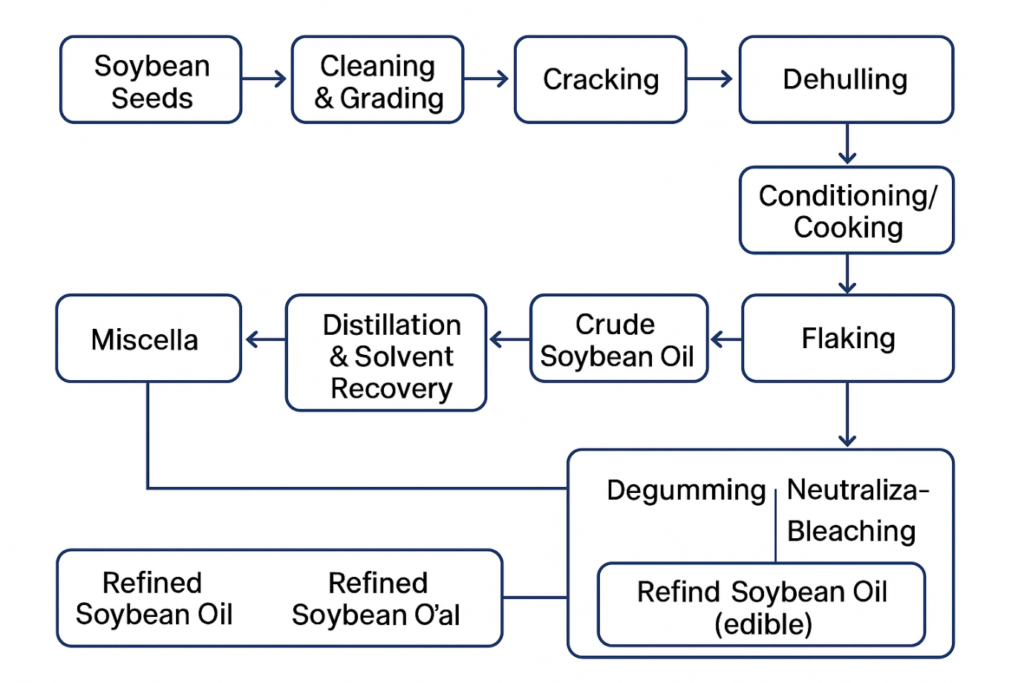
The soybean oil mill plant is a source of several commercially valuable products.
Refined soybean oil is the main product which is a widely used cooking oil in the households, restaurants, and food processing industries.
The de-oiled soybean meal (DOC) with high protein content is a feed ingredient that is in demand all over the world for poultry, dairy, aquaculture, and livestock industries.
Lecithin is one of the main other by-products, which is useful in the bakery, cosmetics, and pharmaceutical industries, among others, distillate fatty acid for biodiesel, and soap and detergent production, and hulls from soybeans for either feed as a source of fiber or biomass burning. The use of these by-products is a way to improve the ROI and at the same time the market diversification.
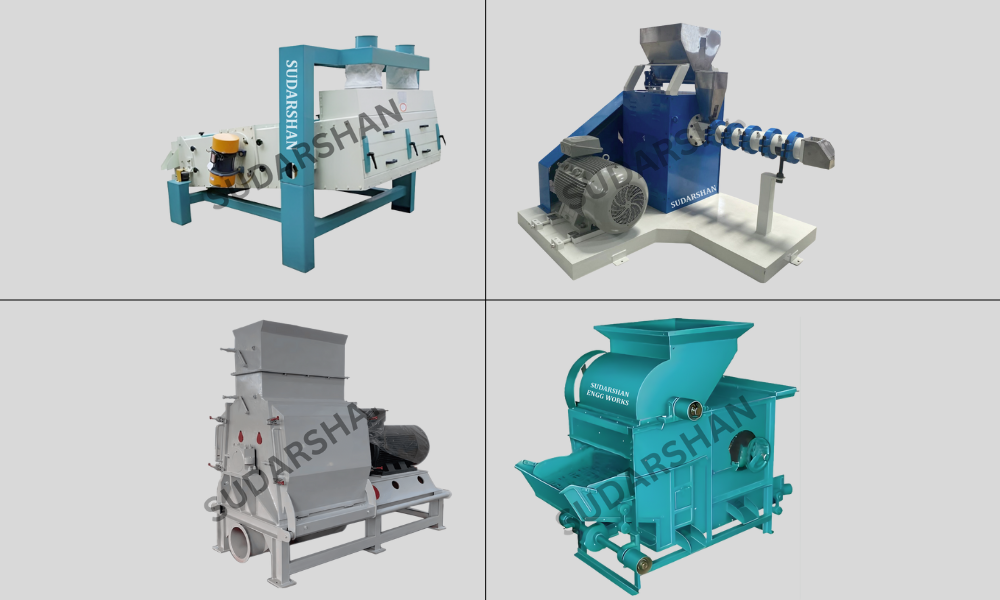
Sudarshan Engineering Works offers total turnkey execution which consists of:
We guarantee that your Soybean Oil Mill Plant starts off the production process smoothly and operates at peak efficiency.
Sudarshan Engineering Works does not only supply Peanut oil extraction machines but it offers total project support-concept to commissioning:
This will guarantee that all clients get ready-to-run Groundnut Oil Extraction Mill Plant which provides high throughput, excellent oil quality, and minimal running costs.
WhatsApp us